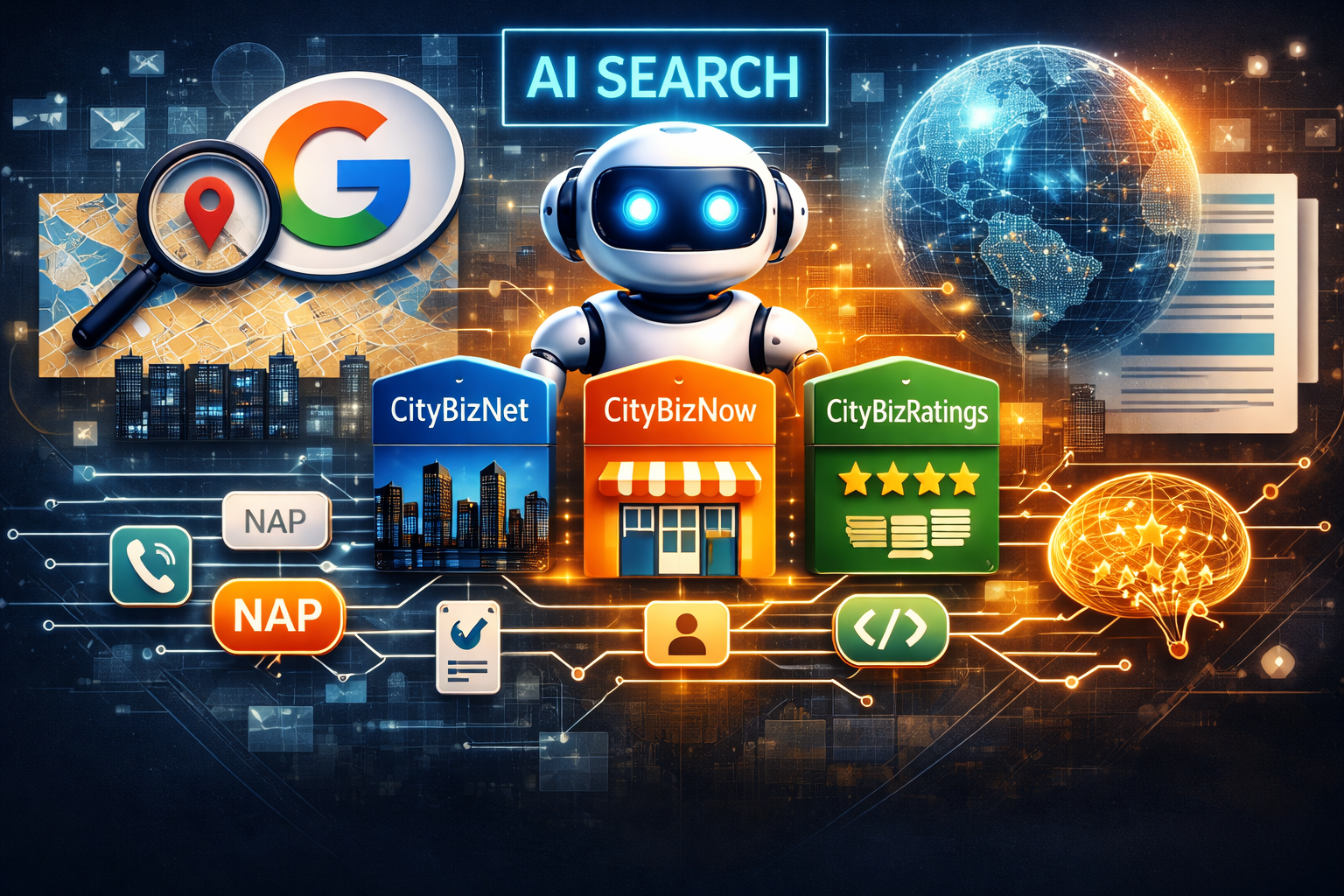
AI-driven search systems validate businesses through entity signals—consistent NAP, structured data, and independent confirmations across trusted sources. Modern, city-focused business directories that publish clean structured listings help reinforce entity identity, improve data confidence, and support stronger discovery in Google and generative search experiences.
The way businesses are discovered online is changing — fast.
Search engines are no longer just crawling webpages. They are building knowledge models, connecting entities, validating facts, and determining trust through structured signals that go far beyond traditional backlinks.
At Bipper Media, we’ve spent years working inside local SEO ecosystems, citation networks, and structured data frameworks. What we’re seeing now is a clear shift:
AI systems don’t “rank pages” the way humans think — they validate businesses through consistency, structure, and entity reinforcement.
This is why a new class of AI-first business directories is emerging — directories built not just for human browsing, but for machine understanding.
Related resources:
For a deeper look at how directories confirm business identity, read
Directories as Entity Confirmations in Modern Local SEO.
To explore how trust and reputation factor into local SEO, check out
Trust Footprints & Directory Signals in Local SEO.
From Links to Entities: How Discovery Has Fundamentally Changed
Historically, directories served two purposes:
- Provide a place for users to browse businesses
- Pass link equity to help with rankings
That model still exists — but it is no longer sufficient.
Modern search engines and AI systems now evaluate businesses through:
- Entity identity (who the business is)
- Entity consistency (how stable its data is)
- Entity relationships (where it is referenced)
- Structured validation (schema, JSON-LD, attributes)
Google is no longer asking “who links to you?” — it’s asking “where does your business exist as a verified entity?”
What We’ve Observed First-Hand at Bipper Media
Through large-scale citation deployment, structured directory publishing, and AI-focused optimization, we’ve consistently observed patterns that show up again and again:
- Businesses referenced across multiple structured directories stabilize faster in search visibility
- Listings with clean schema and consistent NAP are easier for systems to reconcile and trust
- Purpose-built directory pages index more reliably than scraped or low-quality pages
- Entity reinforcement compounds when multiple sources repeat the same core attributes
This isn’t theory — it’s what we see when entity signals are cleaned up and expanded at scale.
Why AI Systems Depend on Directories More Than Ever
AI-driven search (including generative experiences) relies on external confirmation to answer questions like:
- Is this business legitimate?
- Is this business active?
- Is this information consistent across sources?
- How widely is this entity referenced?
Directories act as independent confirmation nodes. But not all directories are equal.
The Rise of AI-Optimized, City-Focused Business Directories
The most effective directories today share common traits:
- City-specific or geo-focused architecture
- Structured data that machines can interpret
- Editorial controls that prevent spam and duplication
- Category and location context that improves entity resolution
CityBizNet
CityBizNet is a city-centric directory built to reinforce business entities at the local level—helping systems connect businesses to geographic relevance with clarity and consistency.
CityBizNow
CityBizNow supports business discovery with clean, structured listing formats across cities and service categories—useful when systems need confidence in “who/what/where” for a business entity.
CityBizRatings
CityBizRatings adds an additional trust layer by incorporating reputation-style context and structured attributes that help both users and AI models evaluate businesses more confidently.
Why Multiple Directories Matter (Even When the Data Is the Same)
A common misconception is that if business information is identical, one source is enough.
In reality, modern systems expect redundancy. Multiple independent confirmations:
- Increase confidence
- Reduce ambiguity in entity resolution
- Improve answer reliability in generative search
- Strengthen trust through independent validation
This mirrors how credible research works: trust rises when multiple sources align.
EEAT in the AI Era: What Actually Signals Trust
Google’s EEAT framework (Experience, Expertise, Authoritativeness, Trustworthiness) increasingly operates at the entity level, not just the page level.
Directories contribute to EEAT by providing:
- Experience — real businesses, real locations, real categories
- Expertise — curated, structured business context
- Authority — consistent references across multiple domains
- Trust — data that is verifiable and repeatable
When these signals align across multiple directories, systems gain confidence in surfacing the business.
Why This Matters for the Future of Search
Search results are increasingly answers, not just lists of links.
AI models don’t browse like people do — they synthesize. That means:
- Entity clarity becomes a competitive advantage
- Structured confirmations matter more than broad claims
- Directories become inputs to “understanding,” not just “visibility”
The Strategic Takeaway for Businesses
If your business only exists on your website, Google Business Profile, and a small set of legacy platforms, you may be under-represented in AI discovery systems.
Strategic placement across AI-optimized directories creates:
- Entity stability
- Discovery resilience
- Compounding trust signals
This is not about chasing rankings — it’s about being understood.
Final Thought
The future of SEO is not louder content. It’s clearer entities.
Businesses that invest early in structured, AI-friendly directory ecosystems will not just rank — they will be recognized, referenced, and recommended by the next generation of search.
Author: Bipper Media Team