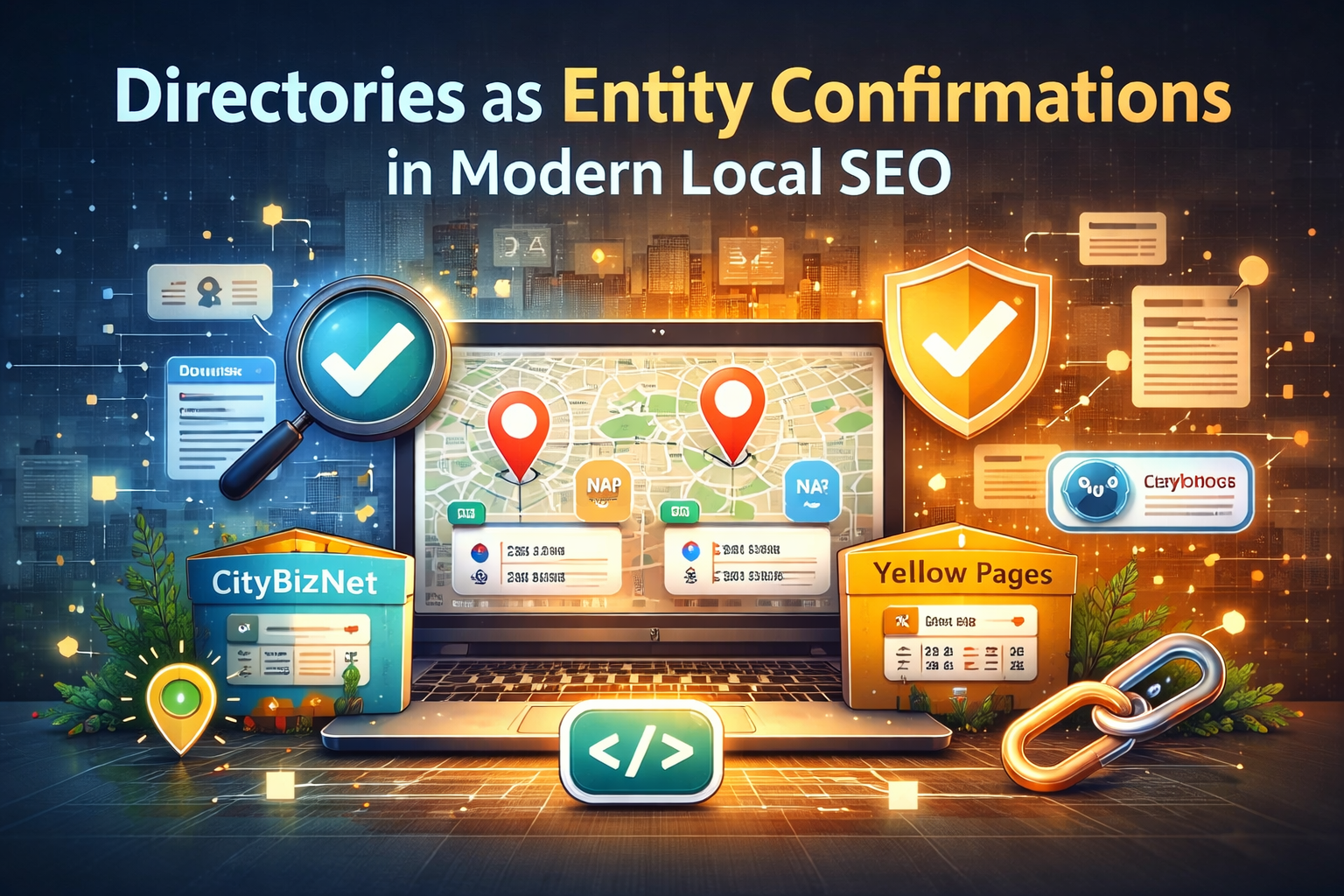
In modern local SEO, directories don’t just “list” businesses—they help search systems confirm entity identity. When structured directory listings repeat consistent NAP, categories, and location context across multiple sources, entity resolution improves and visibility becomes more stable.
For years, local SEO treated directories as a checkbox: submit the listing, match the NAP, move on.
But the current landscape is different. Search systems are increasingly entity-driven. That means directories are no longer just “places your name appears”—they’ve become part of how systems confirm that a business is real, consistent, and accurately understood.
Related resources: For the pillar overview, read
AI-first business directories & entity signals.
For the trust and reputation angle, read
Trust footprints & directory signals.
What “Entity Confirmation” Actually Means
When a system sees a business referenced consistently across multiple sources, it becomes easier to:
- Resolve identity (“this is the same business”) even with small variations
- Trust key attributes (address, phone, hours, category)
- Reduce duplicate entity confusion
- Confidently surface the business in local and generative results
Why City-Focused Directories Often Work Better Than Generic Lists
City-focused directories can add contextual signals that generic directories often lack:
- Stronger geographic framing (“this business belongs here”)
- Cleaner category structures
- More precise internal linking patterns by city and industry
Three City-Based Directories Built for Clarity & Discovery
Examples of city-centric directory properties aligned with entity confirmation include:
- CityBizNet — built around city-centric entity reinforcement
- CityBizNow — structured discovery across cities and categories
- CityBizRatings — adds trust-oriented context for evaluation
What We Recommend (Practical, Not Theoretical)
When we deploy directory and citation strategies, we focus on three fundamentals first:
- Consistency: same NAP, same formatting standards, same business naming rules
- Structure: schema-friendly formatting and category clarity
- Coverage: enough independent confirmations to remove doubt
Done correctly, this reduces confusion and increases confidence—two things modern search systems reward.
FAQ
What is entity confirmation in local SEO?
Entity confirmation is the process where search systems validate a business’s identity and details by comparing consistent signals across multiple independent sources (directories, profiles, and structured listings).
Do I need dozens of directories for entity confirmation?
Not necessarily. Quality and consistency matter most. The goal is enough independent confirmations to reduce ambiguity and help systems reconcile identity with confidence.
Should my internal links be nofollow?
No. Internal links should typically remain dofollow (the default). Internal nofollow usually reduces crawl efficiency and doesn’t help performance.
Author: Bipper Media Team