Before your child’s first day of preschool, grab a piece of paper, a paintbrush, and some washable paint. Hold your little one’s tiny hand in your own and apply a thin layer of colorful paint to their palm. Gently make a print of their precious, chubby fingers—and don’t forget to add the date! Your child’s hand isn’t the only thing that will grow during their time in preschool! Preschool development is an exciting, dynamic process full of endless surprises!
Early childhood development takes place across several distinct areas or “domains.” Teachers at The Learning Experience are masters at crafting activities that allow children to practice new skills in these areas all day long. Sometimes growth happens during circle time, but it also happens on the playground and even during snack time!
You will be able to watch as your child’s relationship to their world shifts and evolves in a million new ways! Do you know what amazing changes to look out for?
Keep reading to discover what to expect by the end of your child’s early education adventure!
The Scoop on Social Development
Preschool is the place where young children learn to coexist with their peers. While friendship is a big component of social development, it’s only one aspect. In preschool, children also learn to resolve conflicts, compromise, and take different perspectives.
All children are naturally egocentric, as described by Renowned developmental scholar Jean Piaget. By the end of preschool, children will be able to imagine what others feel, see, and experience. They will show more interest in following rules and comforting friends.
Emotional development is also a component of social development. Children learn to regulate big emotions. They gain more awareness of their own behavior, leading to better impulse control.
A lot of this growth happens thanks to the intervention of our caring teachers. They have experience spotting a disagreement before it begins! Teachers coach the children through naming emotions and finding solutions, providing them with skills they can ultimately use on their own.
A Focus on Physical Development
In preschool, children develop gross motor and fine motor skills. Gross motor skills are skills involving the large muscle systems of the body. Fine motor skills involve the small muscles in the hands and fingers.
Gross Motor Skills
By the end of preschool, children will have developed stronger gross motor control right on the playground! Children learn to hop, skip, balance, and navigate stairs. Before Kindergarten, most preschoolers have the coordination necessary to ride a bicycle with training wheels!
It’s important to recognize that children’s bodies develop cephalocaudally or from the spine outward. Children must develop their core muscles before they gain the control necessary for writing. Outdoor play is an essential part of growing resilient writers in kindergarten and beyond!
Fine Motor Skills
Fine motor skills are equally essential, as they lead to higher stamina in the elementary classroom. Children build muscles as they sculpt with play-doh, manipulate tweezers, and enjoy fingerplays. By the end of preschool, many children can write their names in legible print.
Hand-Eye Coordination
Gross motor and fine motor development both contribute to stronger hand-eye coordination. As hand-eye coordination improves, so do handwriting and visual art skills. Your child will have an easier time throwing and catching balls, bean bags, and other objects.
Cognitive Development in Action
Cognitive development (or mental development) might be the most exciting domain of all! In preschool, young children learn to reason, plan, and solve problems. More often than not, they develop these skills through play.
Watch as your child tackles a problem. How many solutions do they attempt before giving up and asking for help? Are they able to follow a series of sequential directions?
As cognition improves, children naturally become more independent. Solving problems is satisfying, and they want to do it themselves!
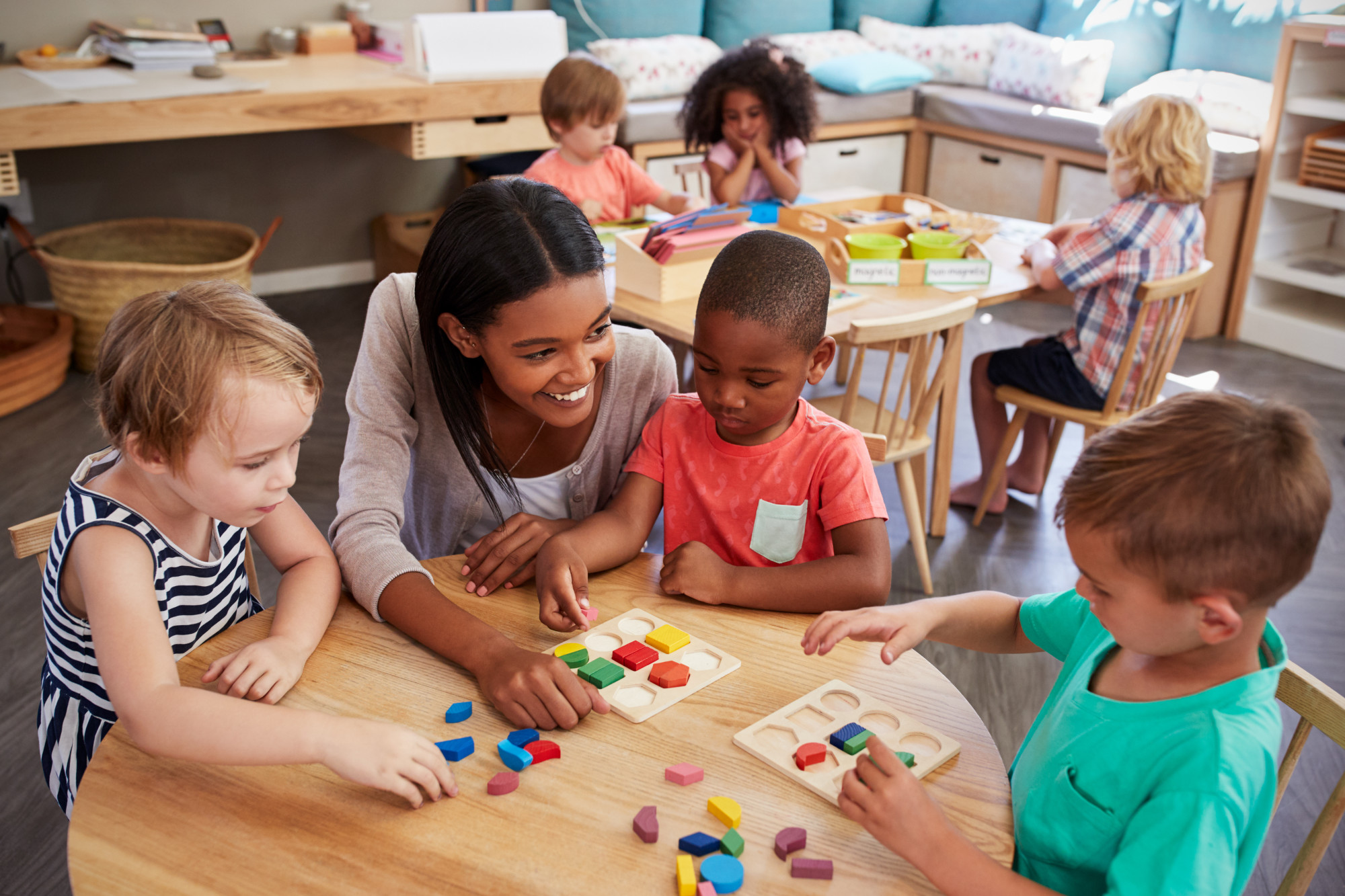
By the end of preschool, many little learners cannot get enough of floor puzzles! They provide just the right amount of cognitive challenge for our fledgling problem solvers! Structures in the blocks area become more impressive and complex as builders apply what they understand about the rules of the physical world.
Talk to your child to better understand his or her sense of logic. It is such a magical time to have a conversation! Their developing understanding of the world and its systems is both charming and illuminating.
Listening in on Language Development
Language development falls into two categories: receptive language development and expressive language development. Receptive language skills are listening skills. Expressive language skills are oral language skills.
Receptive Language
At the beginning of preschool, children might find it challenging to focus during circle time or storytime. They may not realize that the words the teacher is saying have anything to do with them! Over time, they will begin to understand how to pay focused attention and will listen to retain.
You will also see a shift in their ability to follow directions. By the end of preschool, most children will be able to follow multi-step directions. They begin using simple mental tools to help with recall.
Expressive Language
Preschoolers also love to talk! The more words they hear, the more varied and nuanced their vocabulary will become! In the preschool environment, children hear new words all day long—and you’ll hear them at home, too!
Children’s recall will also improve over time. They will come home from school spewing facts about the many wonderful things they’re learning!
They’ll be able to retell the plots of their favorite storybooks and even make predictions about what might happen next. The stories they tell will begin to have a coherent structure with a beginning, middle, and end.
You’ll notice that children will speak in longer sentences. As their language skills grow, you’ll learn so much more about who your child is as a person!
The Beauty of Preschool Development
Although preschool development tends to follow a standard trajectory, it’s important to remember that every child is unique. Every preschooler’s development journey will look a little different! Luckily, caregivers at The Learning Experience know how to differentiate classroom activities to make sure that every friend gets what they need!
Are you ready to see childhood development in action? Stop by The Learning Experience in Long Island City to see growth in action! Reach out today to schedule your tour.
The Learning Experience – Long Island City
27 – 28 Thomson Ave
Long Island City, NY 11101
(718) 433-4007
https://thelearningexperience.com/center/long-island-city/