



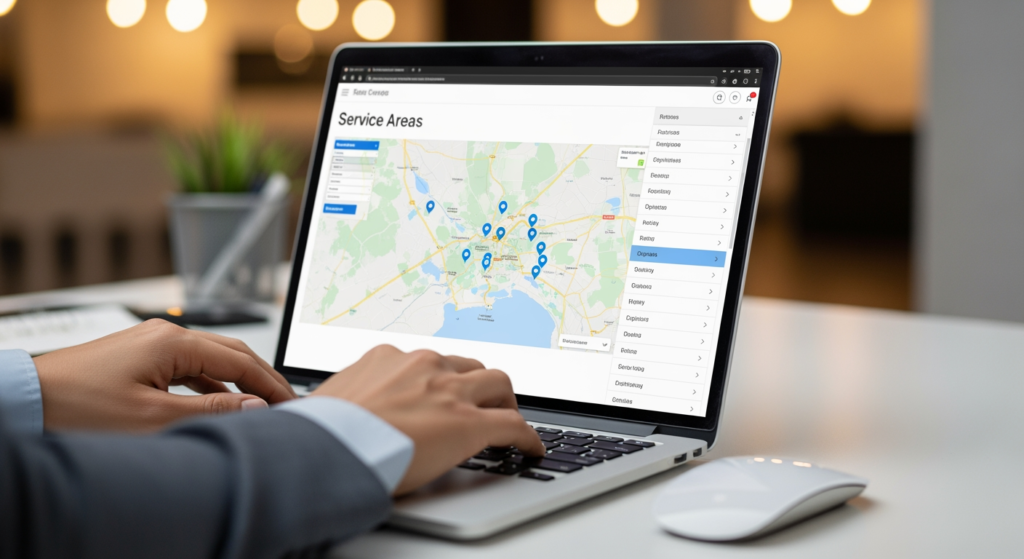
Service area pages are one of the most practical ways for a local business to show search engines (and customers) where you work—without turning your website into a messy list of cities. If you serve multiple towns, neighborhoods, or regions, these pages can help you match local search intent, clarify your coverage, and route visitors to the right next step. This guide is for business owners, marketers, and web teams who want to build location-focused pages that are useful, compliant, and scalable. Done well, they support stronger local relevance and better user experience; done poorly, they can create thin, repetitive content that doesn’t earn trust. Below is a 2026-ready framework you can use to plan, write, optimize, and maintain them with confidence.
If you’re building your local strategy from the ground up, it helps to understand the bigger picture first—see Understanding the Importance of Local SEO for Business Visibility for a clear overview of how local signals work together.
Bottom Line Upfront: What to Do With Service Area Pages
- Create one page per meaningful location cluster (city, region, or neighborhood group), not one page for every keyword variation.
- Write unique, location-specific information that reflects how you actually serve that area (services, response times, constraints, common requests).
- Use a clean URL and internal linking structure so users and crawlers can find these pages easily.
- Include clear conversion paths (call, form, booking) and trust elements (licenses, service boundaries, FAQs, reviews where appropriate).
- Avoid “copy/paste city swaps” and doorway-page tactics; prioritize usefulness and accuracy.
- Track performance by page and refine based on real queries, leads, and on-page engagement.
How Location-Focused Pages Actually Work for Local SEO
At their core, these pages help align three things: what a person searches, what you offer, and where you offer it. When someone searches for a service in a specific place, search engines look for evidence that your business is relevant to that location and capable of serving the need. A well-built location page makes that relevance explicit—without forcing users to guess whether you cover their area.
In 2026, quality signals matter more than sheer volume. Instead of publishing dozens of near-identical pages, aim for fewer pages with stronger differentiation. That differentiation can come from service nuances (what’s popular in that area), operational reality (travel fees, same-day availability, service radius), and localized proof (case examples, project types, area-specific FAQs).
What a “good” page communicates
- Coverage clarity: the area you serve and any boundaries (zip codes, counties, “north of X highway,” etc.).
- Service fit: which services are available there, and which are not (if applicable).
- Trust and legitimacy: business details, credentials, and policies that reduce friction.
- Next step: a single, obvious action for the visitor to take.

The Real-World Impact on Leads, Budget, and Maintenance
These pages can be a strong local SEO asset, but they’re not “set it and forget it.” The main tradeoff is between coverage and upkeep. More pages can mean more opportunities to match searches, but it also increases the risk of thin content, outdated details, and confusing navigation.
- Time cost: writing truly unique content takes longer than swapping city names, but it’s more defensible and more useful.
- Quality control: inconsistent service boundaries, outdated pricing policies, or incorrect local references can reduce trust.
- Conversion performance: a page that ranks but doesn’t convert is still a problem—calls to action, proof, and clarity matter.
- Technical overhead: templates, internal linking, and indexing control (canonical tags, noindex where appropriate) require coordination.
Also note: SEO outcomes vary by market competition, site quality, and how well the page matches user intent. Treat these pages as part of a system (website + Google Business Profile + listings + reviews), not a standalone trick.
Common Service Area Page Mistakes (Use This Checklist)
- Publishing “doorway” pages: dozens of near-duplicates targeting tiny variations can look manipulative and unhelpful.
- Copy/paste with only city swaps: if the page reads like a template, users notice—and search engines often do, too.
- Unclear boundaries: saying “we serve everywhere” without specifics can create confusion and low-quality leads.
- Thin pages with no substance: a paragraph and a phone number usually isn’t enough to earn trust or relevance.
- No internal linking plan: orphan pages (not linked from anywhere) are harder to crawl and less likely to perform.
- Forgetting mobile UX: slow load times, cluttered layouts, or hard-to-tap buttons can kill conversions.
- Ignoring intent differences: “emergency” queries, “near me,” and “cost” searches often need different on-page answers.
- Inconsistent business info: mismatched phone numbers, names, or addresses across the site can create credibility issues.
A Smart Build Framework You Can Implement This Week
- Choose your page model: city pages, county/region pages, or neighborhood clusters based on how customers describe your area.
- Define real coverage: list zip codes, counties, or drive-time rules; add notes about travel fees or exceptions if they exist.
- Use a consistent URL pattern: keep it readable (e.g., /service-areas/city-name/) and avoid parameter-heavy URLs.
- Write unique “local proof” blocks: common projects, typical timelines, seasonal needs, or neighborhood-specific constraints.
- Map services to the location: include only the services you truly offer there; link out to core service pages where relevant.
- Add conversion essentials: click-to-call, a short form, or booking—plus hours and response expectations.
- Strengthen trust signals: licensing/insurance notes (if applicable), warranties, process steps, and customer-friendly policies.
- Build internal links intentionally: link from your main navigation or a “Service Areas” hub, and cross-link related nearby areas when helpful.
- Implement basic schema where appropriate: use accurate structured data consistent with your business details and page content.
- Measure and iterate: track impressions, clicks, calls/forms, and on-page engagement; update pages quarterly or when coverage changes.

Professional Insight: What Most Businesses Miss
In practice, we often see service-area content fail not because the business picked the “wrong” cities, but because the pages don’t answer the visitor’s real question: “Can you help me here, and what happens next?” The pages that tend to perform better are the ones that reduce uncertainty—clear boundaries, clear services, clear expectations, and a clear next step—without trying to sound like a robot rewriting the same paragraph 40 times.
When DIY Service Area Pages Stop Making Sense
Consider getting professional help when:
- You’re expanding into many locations: scaling content without duplication issues usually requires a strategy and templates done right.
- Pages aren’t indexing or performing: you may have technical problems (crawl paths, cannibalization, thin content signals).
- You’re unsure about boundaries: if your coverage is complex (multiple crews, different service lines), clarity matters.
- Leads are low quality: the page may be too vague, attracting out-of-area requests or mismatched intent.
- Your site structure is messy: navigation, internal linking, and on-page hierarchy often need a rebuild for scale.
Frequently Asked Questions
How many location-focused pages should a local business create?
It depends on how many distinct areas you truly serve and how different those areas are in terms of services, logistics, and customer needs. A smaller set of high-quality pages is usually easier to maintain than a large set of near-duplicates.
Should I make a page for every suburb and neighborhood?
Only if you can provide genuinely unique, helpful content for each one and you have a clear internal linking plan. If the content would be nearly identical, consider combining nearby areas into a stronger regional page.
What should I include on a page to improve conversions?
Focus on clarity and trust: the exact services offered, boundaries/coverage rules, hours or response expectations, proof elements (credentials, process, policies), and one obvious call to action such as calling or requesting a quote.
Can these pages hurt my SEO if done incorrectly?
They can create issues if they’re thin, duplicative, or confusing to navigate. That’s why it’s important to prioritize usefulness, accuracy, and a structure that helps both users and search engines understand your coverage.
Do I need a separate page if I don’t have an office in that city?
Not necessarily. If you legitimately serve the area, you can create a page that explains how you serve customers there without implying a physical location. The key is to be transparent about your service model and boundaries.
Moving Forward
Service area pages work best when they’re built for humans first: clear coverage, clear services, and clear next steps. Use fewer pages with stronger differentiation, maintain them like real assets, and support them with a solid local SEO foundation. If you treat these pages as part of a cohesive site structure—not a quick workaround—you’ll be in a better position to earn relevant visibility over time.
Learn More About Our Services
Discover how we can help you achieve your goals.
