



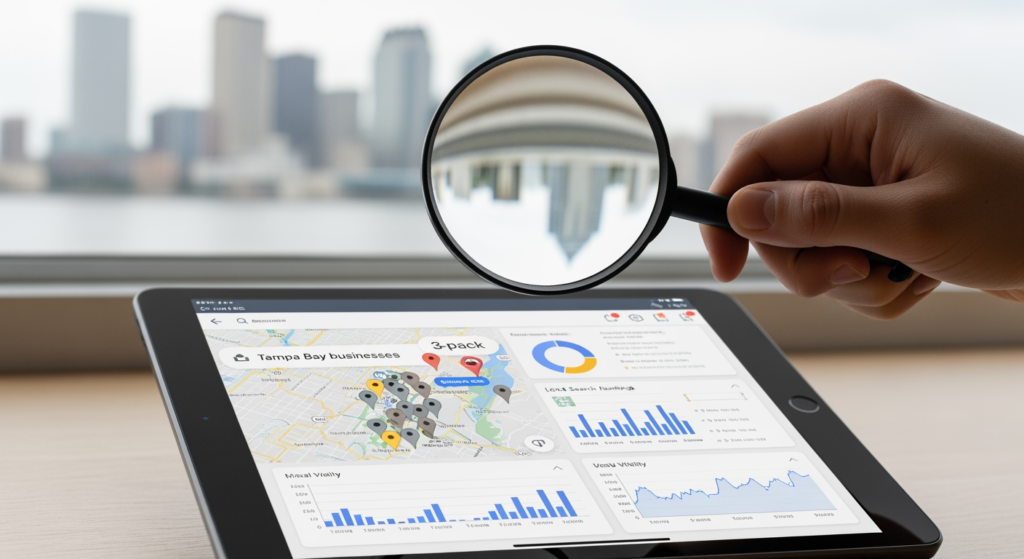
Local business owners in Tampa, Florida often notice a frustrating pattern: you were showing in the Map Pack, then suddenly you’re not. If you’re searching for google maps ranking tampa answers, the real issue is usually not one “hack” you missed—it’s that Google’s local system is weighing trust, relevance, and proximity signals differently than you expect. That matters because the 3-Pack is where high-intent customers make fast decisions, and disappearing can reduce calls, direction requests, and booked jobs.
This FAQ-style guide focuses on the most common, fixable reasons businesses drop out of the 3-Pack (or never enter it). If you want the foundational model behind what influences placement, start with how Google Maps ranking actually works.
The Short Answer: Why Businesses Fall Out of the 3-Pack
- Your relevance signals weakened (categories, services, content, or on-site alignment no longer match what searchers want).
- Your trust signals are inconsistent (NAP mismatches, duplicate listings, or conflicting business details across the web).
- Your organic authority isn’t supporting Maps visibility (your website and brand signals don’t reinforce your local relevance).
- You’re being filtered (Google may suppress similar businesses at the same address or very close proximity).
- Competition changed (a competitor improved their profile, content, or authority—and you didn’t).
Why the Map Pack Changes (Even When You Didn’t “Do Anything”)
The 3-Pack is not a static leaderboard. It’s a dynamic result set that changes based on the searcher’s location, the exact wording of the query, business categories, and Google’s confidence that your business is the best match for that specific search. Even small shifts—like a category change, new competitors entering the area, or inconsistent business details—can change who appears.
Another common reason: business owners assume their Google Business Profile is the whole game. In practice, Google cross-checks what’s in your profile against other sources (your website, citations, reviews, and general brand presence). When those signals don’t align, your visibility can become unstable.

The Real Cost of Dropping Out of Maps Visibility
When you disappear from the 3-Pack, the impact is usually immediate because Maps traffic is often “ready-to-buy” traffic. The practical costs show up as fewer calls, fewer form fills, and fewer direction requests—especially for service categories where customers compare only a few options.
It can also create a compounding problem: lower visibility can reduce engagement signals (clicks, calls, requests), and reduced engagement can make it harder to regain momentum—particularly in competitive categories.
Common Missteps That Push You Out of the 3-Pack (Checklist)
- Wrong primary category — If your main category doesn’t match your core service, Google may treat you as less relevant for your best queries.
- Service list doesn’t match the website — If your profile claims services your site barely mentions (or doesn’t support), Google’s confidence can drop.
- Inconsistent business info (NAP) — Name, address, or phone variations across directories can dilute trust and create confusion.
- Duplicate or old listings — Extra profiles (or old addresses) can split signals and trigger suppression.
- Thin location/service pages — Pages that feel generic or repetitive often fail to support local relevance and authority.
- Review profile is “lopsided” — Not just quantity; patterns like sudden bursts, missing responses, or reviews that don’t mention what you do can reduce clarity.
- Ignoring proximity realities — If you’re far from the searcher, you may only show when your authority and relevance are strong enough to compete.
- GBP changes without a plan — Frequent edits to categories, names, or addresses can create volatility while Google re-evaluates the listing.
A Practical Recovery Plan for Local Map Pack Performance (Checklist)
- Confirm your primary category and top secondary categories match your highest-value services.
- Align your website’s core pages with your GBP (services offered, terminology, and proof of expertise).
- Audit for duplicates and inconsistencies in business name, address, and phone across major listings.
- Strengthen “proof” content (clear service explanations, FAQs, project examples, and policies that reduce ambiguity).
- Build a review system you can sustain (steady volume, thoughtful responses, and service-specific language when it’s natural for customers).
- Improve internal linking and page hierarchy so Google can understand which pages represent your main offerings.
- Track changes and outcomes (log profile edits, ranking shifts, and lead volume so you can isolate what helped or hurt).
Why Competitors Rank Higher Despite Poor Websites
In practice, we often see businesses focus on design or a single optimization while their competitor wins because the overall entity signals are clearer: consistent business information, a tighter category/service match, stronger topical relevance on the website, and a review profile that reinforces what they’re known for. The competitor’s site may look “worse,” but it can still communicate relevance and trust more directly to search systems.
When It’s Time to Bring in Local SEO Help
Consider professional support if any of these are true:
- Your listing is suspended, disabled, or repeatedly needs reverification (these require careful handling to avoid delays).
- You suspect duplicates, merges, or address-related filtering and you’re not sure what to change without risking visibility.
- You’ve made multiple GBP edits and rankings became unstable for weeks.
- Your leads dropped suddenly and you need a diagnostic approach (not random tactics).
- You operate in a competitive category where authority and website support are now required to consistently appear.
Your Questions, Answered: Local Map Pack Visibility
Why did my business disappear from the Map Pack overnight?
Common causes include recent profile edits, category mismatches, inconsistent business information across the web, duplicate listings, or a competitor improving their relevance and authority. It can also be a “filtering” situation where Google suppresses similar businesses near the same address.
Is proximity still the biggest factor for showing in Google Maps?
Proximity matters, but it doesn’t operate alone. Google still needs confidence that your business is relevant to the query and prominent enough to deserve placement. In competitive areas, stronger authority signals can help you show more consistently across a wider radius.
Can my website affect my Google Business Profile visibility?
Yes. Your site helps confirm what you do, where you operate, and how trustworthy your business appears. If your site doesn’t clearly support your primary services (or conflicts with your profile), your Maps visibility can become harder to maintain.
Do reviews and citations guarantee better local visibility?
No. Reviews and citations can help, but they work best when they reinforce clear relevance and consistent business details. If categories, services, or on-site signals are weak, reviews alone may not stabilize Map Pack placement.
How long does it take to recover after making changes?
Timelines vary. Some updates are reflected quickly, while others require Google to reprocess multiple signals across your profile and the broader web. The more variables you change at once, the harder it is to identify what actually improved performance.
Moving Forward
Dropping out of the 3-Pack is usually a signal mismatch problem: Google is less confident about relevance, trust, or prominence for the searches that matter to you. Focus on aligning your Google Business Profile, your website, and your broader business information so the system sees one consistent story. When you approach it as a diagnostic process—not a checklist of tricks—you can build visibility that holds up through competition and algorithm shifts.
Still have questions?
If you’re not sure what changed (or what to fix first), write down the last edits you made, the queries that matter most, and what you’re seeing in leads. That context makes it much easier to pinpoint whether you’re dealing with relevance, trust, filtering, or competitive displacement—especially for businesses targeting google maps ranking tampa outcomes.
Get in Touch
Fill out our quick form and we’ll get back to you within 24 hours.
