



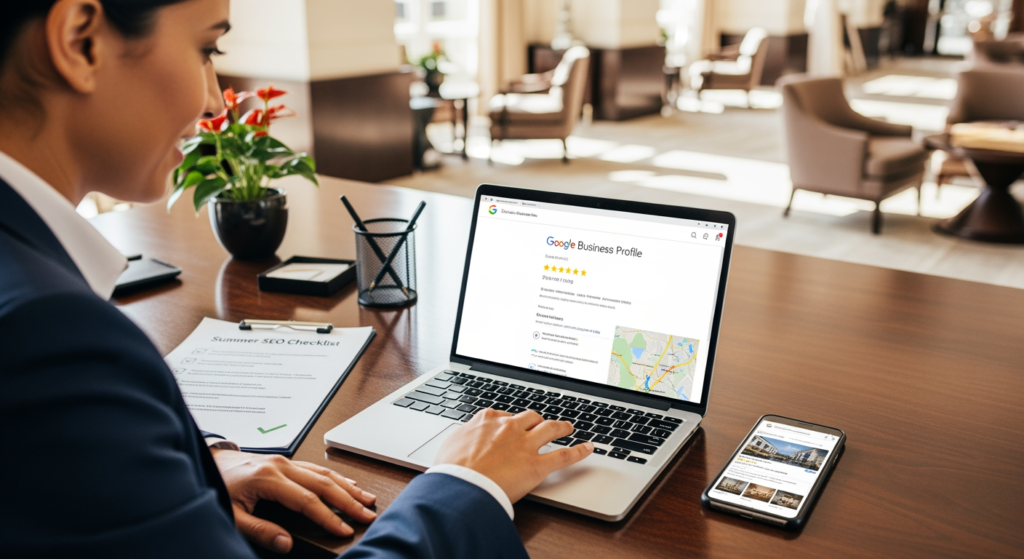
Summer travel demand can spike fast, and hotels that are easy to find (and easy to trust) often win the click before a guest ever compares room photos. If you’re a hotel owner, GM, or marketing lead, this checklist is designed to help you tighten up your hotel local SEO so your property shows accurate info everywhere travelers search. The goal isn’t “SEO tricks”—it’s reducing friction: wrong hours, mismatched phone numbers, outdated amenities, thin location pages, and reviews that go unanswered. Those small gaps can quietly cost bookings during peak season.
If you want a stronger foundation first, start with Understanding the Role of Google Business Profile in Local SEO Success, then come back and work through the summer-specific items below.
The Essentials for Summer Visibility
- ✓ Make your listings consistent across Google and major directories so travelers see the same name, address, and phone number everywhere.
- ✓ Refresh your Google Business Profile with current categories, amenities, photos, and seasonal updates that match what guests will experience.
- ✓ Build (or improve) location intent on your site with clear “near” language, directions, parking info, and neighborhood context.
- ✓ Treat reviews like a conversion channel by replying quickly and using responses to clarify policies and amenities.
- ✓ Track what matters weekly: calls, direction requests, website clicks, and top queries—then adjust content and photos accordingly.
How Local Search Works for Hotels (In Plain English)
Local search for hotels is largely about matching a traveler’s intent (where they are or where they’re going) with trustworthy business data. Search engines look for signals that your property is legitimate, relevant, and accurately described: consistent business details across the web, a well-optimized Google Business Profile, strong on-site location information, and active reputation management.
In summer, intent tends to be more time-sensitive (same-day or weekend trips), so accuracy and clarity matter even more. If your amenities, policies, and location details are easy to confirm, you remove doubt—and doubt is the enemy of bookings.
The Real Cost of Skipping Summer Local Optimization
- Lost direct bookings: If your phone number, website link, or hours are wrong, guests may book elsewhere instead of calling you.
- More front-desk friction: Confusing policies (parking, pet rules, check-in times) drive repetitive calls and unhappy arrivals.
- Lower trust at the moment of choice: Outdated photos or unanswered reviews can make your property feel neglected—even if it’s not.
- Wasted marketing spend: If you run promotions but your listings and landing pages don’t match, you pay for attention that doesn’t convert.
Common Summer SEO Missteps Hotels Should Avoid
- ✓ Leaving seasonal hours and policies unclear (Priority: High) — If your pool hours, breakfast schedule, or parking rules change in summer, update them everywhere, not just on a flyer at the desk.
- ✓ Using the wrong primary category (Priority: High) — Your main category should reflect what you are (hotel, motel, resort, etc.). Extra categories should be accurate—not aspirational.
- ✓ Posting photos that don’t match the current guest experience (Priority: High) — Renovated rooms, updated lobby, new fitness area: refresh images so expectations match reality.
- ✓ Letting old Q&A answers linger (Priority: Medium) — Outdated answers about pets, deposits, or shuttle service create confusion and negative reviews.
- ✓ Publishing thin “Things to Do” pages (Priority: Medium) — A generic list doesn’t help guests or search engines. Tie content to your neighborhood, drive times, and seasonal events.
- ✓ Ignoring duplicate listings (Priority: Medium) — Duplicate profiles split signals and can misroute calls or directions.
A High-Priority Summer Action Plan (Do This First)
- ✓ Audit your NAP consistency (Priority: High) — Confirm your exact hotel name format, address suite/unit formatting, and primary phone number match across your website, Google profile, and key directories.
- ✓ Update Google Business Profile core fields (Priority: High) — Check categories, attributes/amenities, check-in/check-out info, and the website URL. Remove anything you no longer offer.
- ✓ Add summer-relevant photos (Priority: High) — Upload current exterior (daylight), lobby, 2–3 room types, pool/amenities, and parking/entrance photos. Prioritize clarity over artistry.
- ✓ Publish a weekly Google update (Priority: High) — Post seasonal offers, event weekends, or amenity highlights. Keep it accurate and aligned with on-site landing pages.
- ✓ Create (or improve) a “Location & Parking” section on your site (Priority: High) — Include parking costs, EV charging (if available), nearest highway/landmarks, and simple directions. Add a short “near” paragraph that reflects real proximity.
- ✓ Build 2–4 neighborhood pages guests actually want (Priority: Medium) — Examples: “Near the Convention Center,” “Near the Stadium,” “Near Downtown Dining,” “Near the Beach.” Each should include travel time, parking tips, and a short FAQ.
- ✓ Request reviews at the right moment (Priority: High) — Ask post-stay via email/SMS (where permitted) and train staff to invite feedback at checkout for happy guests.
- ✓ Respond to reviews with a repeatable template (Priority: High) — Thank them, address the specific point, clarify a policy when needed, and invite offline follow-up. Keep it human.
- ✓ Check your top local queries weekly (Priority: Medium) — Look for patterns like “pet friendly,” “parking,” “pool,” “breakfast,” “near [attraction].” Then update your site copy and GBP Q&A to reduce uncertainty.
- ✓ Downloadable summary: 10-minute weekly routine (Priority: High) — Every week: (1) add 3–5 new photos, (2) publish one update, (3) respond to all new reviews, (4) spot-check NAP on your top listings, (5) review calls/directions clicks.

Professional Insight: What Most Hotels Miss in Peak Season
In practice, we often see hotels focus on promotions while leaving “decision details” scattered or outdated—parking, deposits, pet rules, breakfast hours, and check-in logistics. Tightening those specifics across your website and listings tends to reduce guest hesitation and prevent avoidable negative reviews.
When DIY Isn’t Enough (And It’s Time to Get Help)
- ✓ You find duplicate or unclaimed listings and calls/directions are going to the wrong place.
- ✓ Your hotel details don’t match across platforms (name formatting, address, phone, website), and you don’t have time to chase each directory.
- ✓ Reviews mention “misleading info” (hours, amenities, policies) more than once—this is usually a consistency problem.
- ✓ You’ve updated your Google profile but visibility is still inconsistent and you need a broader local strategy (site content, authority building, technical cleanup).
- ✓ Your team is stretched thin and weekly updates/review responses aren’t happening reliably.
Common Questions Hotel Teams Ask
How often should we update our Google Business Profile in summer?
Weekly is a practical cadence for posts and photo additions during peak season. Core details (hours, amenities, phone, website) should be updated immediately whenever they change.
What photos matter most for local search conversions?
Clear, current photos that reduce uncertainty: exterior/entrance, lobby, representative room types, key amenities (pool, breakfast area, gym), and parking/arrival flow.
Do reviews affect visibility, or just trust?
Reviews primarily influence trust and conversion, and they can also support local relevance signals over time. The most controllable part is responding consistently and addressing recurring issues.
Should we create pages for nearby attractions and venues?
Yes, if they’re genuinely relevant to your guests and you can add useful details (travel time, parking tips, seasonal notes). Avoid thin pages that don’t add value beyond a generic list.
What’s the fastest way to spot listing inconsistencies?
Start with your website, Google profile, and a short list of major directories where you already get traffic. Compare name, address formatting, phone, and website URL side-by-side and fix mismatches.
Taking Action Before Summer Bookings Peak
This checklist is meant to help you tighten accuracy, improve trust signals, and make it easier for travelers to choose your property quickly. Start with consistency and your Google profile, then reinforce it with location-focused website content and a simple weekly routine. If you keep the details aligned, your marketing has a cleaner path to convert.
Want More Information?
Download our free resource to learn more about this topic.
