



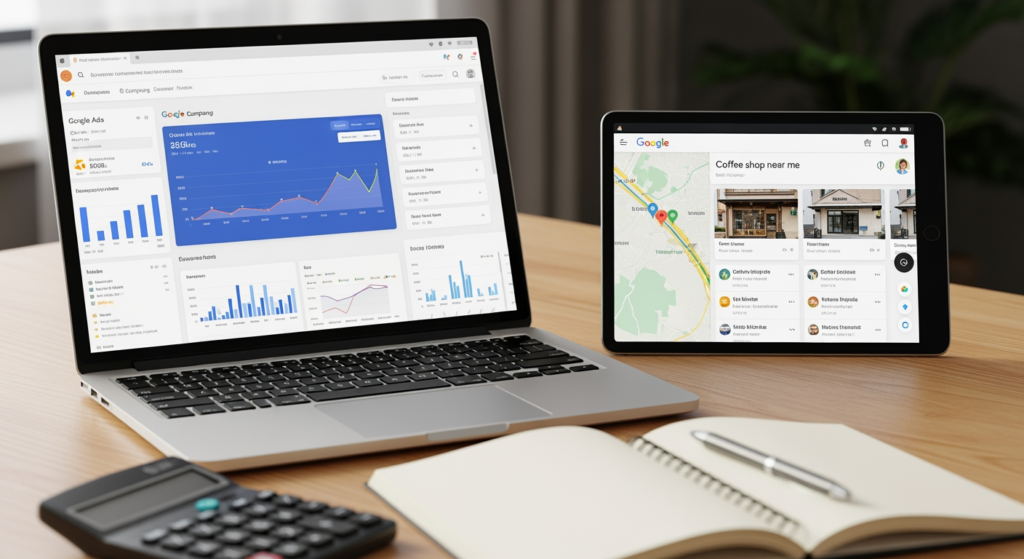
Choosing between long-term visibility and immediate leads usually comes down to budget, patience, and how competitive your market is. If you’re a local business owner trying to decide on local SEO vs Google Ads, the cost conversation can get confusing fast—especially when one option looks like a “monthly retainer” and the other looks like a “pay-per-click meter” that never stops running. Both can work, but they behave differently over time, and they fail differently when they’re set up wrong.
This guide compares costs, value, timelines, and best-fit use cases so you can pick a plan that matches your goals. If you want the bigger-picture foundation behind local visibility, start with Understanding Local SEO for Small Businesses.
The Essentials: Cost Comparison at a Glance
- Google Ads is typically faster to turn on, but costs scale directly with clicks and competition in your area.
- Local SEO is usually slower to build, but value can compound as your site and listings earn trust over time.
- Ads costs are more “metered” (spend more to appear more), while SEO costs are more “investment-like” (pay to build assets and authority).
- Best short-term play: Ads for launches, promos, seasonal surges, and urgent lead needs.
- Best long-term play: Local SEO for consistent discovery in Maps and organic results without paying per click.
- Most practical approach for many businesses: use Ads for immediate demand while SEO builds a durable pipeline.
Breaking Down What You’re Actually Paying For
Cost comparisons get messy when you compare a monthly SEO fee to an ad budget. They’re not the same type of expense. A cleaner way is to compare what the money produces.
| Criteria | Local SEO | Google Ads |
|---|---|---|
| What you’re buying | Website + local signals (GBP optimization, citations, content, technical fixes) | Visibility in ad placements based on bids, quality, and targeting |
| How costs behave | More stable month-to-month; scope-driven | Spend-driven; costs change with competition and click volume |
| When results can appear | Often gradual; depends on baseline and competition | Often quickly after launch (once approved and configured) |
| What happens if you stop paying | You may retain some gains, but momentum can slow over time | Traffic typically stops when spend stops |
| Best for | Ongoing local discovery and credibility | Immediate lead capture and controlled targeting |
In plain terms: local SEO costs are usually tied to work performed (fixing, building, optimizing), while Ads costs are tied to exposure and demand (bids, clicks, auctions).

The Real-World Stakes: Budget, Timing, and Lead Flow
When you choose between SEO and Ads, you’re also choosing which risk you can tolerate:
- Cash-flow risk: Ads can generate leads quickly, but spend can climb in competitive categories. SEO is often steadier, but you’re paying before you fully see the payoff.
- Timing risk: If you need calls this week, Ads is usually the more direct lever. If you’re planning for the next 6–12 months, SEO can reduce dependence on paid clicks.
- Conversion risk: Ads can send traffic fast—even to a weak landing page. SEO typically forces you to improve the site, content, and local trust signals, which can help conversion quality over time.
Cost/value also depends on what you sell. A high-margin service can often justify a higher cost per lead than a low-margin one. (Your actual results will vary based on market competition, offer strength, and website performance.)
Common Cost Traps to Avoid (Checklist)
- Comparing SEO fees to ad spend without including management costs: Ads often require ongoing setup, testing, and landing page work to perform well.
- Running Ads to a generic homepage: This can inflate cost per lead because the page doesn’t match the search intent.
- Ignoring tracking: If calls, forms, and booked jobs aren’t tracked, it’s hard to know what you’re paying for.
- Assuming SEO is “set it and forget it”: Local competition changes, listings drift, and content gets outdated.
- Over-focusing on cheapest clicks: Low-cost clicks aren’t a win if they don’t turn into qualified leads.
- Not aligning geography: Ads targeting and local SEO service areas should match where you actually serve customers.
A Practical Decision Plan for Most Local Businesses (Checklist)
- Define your goal by timeframe: “Leads this month” (lean Ads) vs. “visibility this year” (lean SEO).
- Estimate your lead value: Know your average job value and realistic close rate before setting budgets.
- Fix the conversion path first: Clear service pages, fast load times, strong calls-to-action, and easy contact options.
- If you run Ads, start tight: Focus on high-intent keywords, limited geography, and a dedicated landing page.
- If you invest in local SEO, start with foundations: Google Business Profile basics, consistent NAP, core service pages, and review strategy.
- Review monthly with one scoreboard: Leads, booked jobs, and cost per lead (not just clicks or rankings).

Professional Insight: Where Cost Comparisons Usually Go Sideways
In practice, we often see businesses judge costs based on the first 30 days. Ads can look “better” early because traffic appears quickly, while SEO can look “expensive” because the benefits build gradually. The more useful comparison is whether each channel is improving your lead quality and consistency—and whether your website and tracking are strong enough to capitalize on either one.
When DIY Isn’t Enough: Signs You Should Get Help
- Your ad spend is rising but leads aren’t: This can indicate targeting issues, weak landing pages, or tracking gaps.
- You’re not showing in Maps for core services: Often tied to GBP setup, category choices, citations, or on-site local relevance.
- You don’t know which calls came from where: Without attribution, it’s easy to overspend or cut the wrong channel.
- Your site can’t support conversions: Slow pages, unclear service info, or poor mobile experience can waste both SEO and Ads budgets.
- You’re entering a more competitive market: The more crowded the space, the more strategy and testing matter.
Common Questions Answered
Which option is cheaper for a small business?
It depends on your market and goals. Paid campaigns can start with smaller budgets but may become more expensive as competition increases. Local optimization can have steadier costs, but it usually takes time to build momentum.
How do I compare value if one is monthly and the other is pay-per-click?
Use a shared metric like cost per qualified lead or cost per booked job. Make sure call and form tracking are set up so you’re comparing outcomes, not just traffic.
Can I run paid search and local optimization at the same time?
Yes. Many businesses use paid campaigns for immediate demand while improving their website, listings, and content for longer-term visibility.
What if I stop running ads?
In many cases, traffic from paid placements drops quickly when spend stops. Any ongoing visibility you have would then rely on your organic presence, your Google Business Profile, and your existing brand demand.
What should I fix first if my budget is limited?
Start with fundamentals that improve conversion and trust: accurate business information, a clear service offering on your site, and basic tracking. Then choose the channel that best matches your timeline.
Taking Action
Comparing costs is only useful if you match the channel to your timeline and your ability to convert leads. Ads can be a strong lever for fast visibility, while local SEO can build a more durable presence that supports consistent discovery. For many local businesses, the smartest plan is a balanced mix—paid for immediate demand, and SEO to reduce long-term reliance on clicks.
Get Your Free Quote
Find out how we can help with a no-obligation quote.
