from 80 reviews on Google
Increase your visibility across Google Search, Google Maps, ChatGPT, and other AI-powered search experiences. Bipper Media combines Google Business Profile optimization, local citations, location-focused content, technical SEO, schema, and authority building to help search engines and AI platforms better understand and trust your business.
Our local SEO services strengthen local rankings, improve AI visibility, and help your business generate more qualified calls, website leads, and long-term growth.


Use the free checker to review a website’s current authority signals, then connect the result to the broader SEO work that may improve relevance, technical quality, content coverage, and trusted links. The score is a diagnostic signal, not a guarantee of Google rankings.
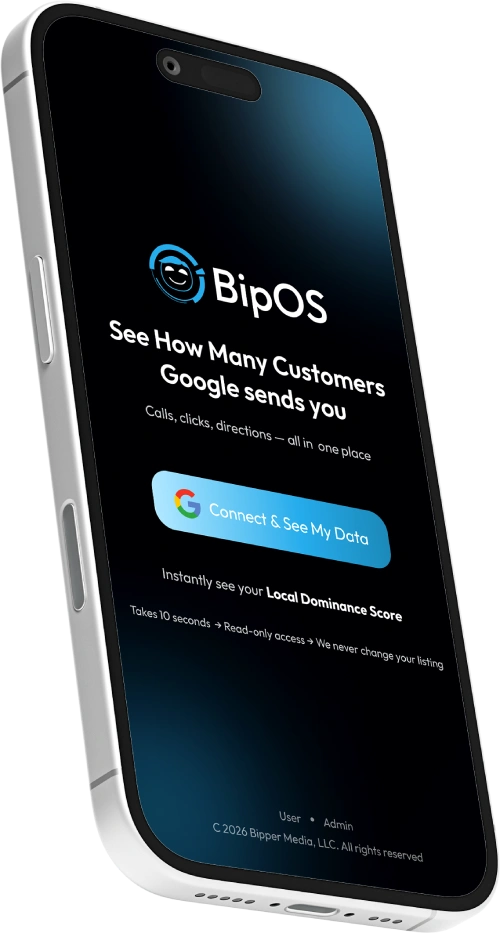
Manage your SEO, approve posts, and keep an eye on every client — right from your phone. Real-time alerts mean nothing slips through the cracks.


Free for all BipOS clients & white-label partner admins.
★★★★★ Rate on the App Store
Businesses use Bipper Media for local SEO, citation services, content support, and website solutions. Explore verified reviews, selected projects, and current company statistics throughout this page.
When people search for a nearby service, Google evaluates relevance, location, business information, website quality, reviews, and authority. Incomplete or inconsistent signals can make a strong business difficult to find in local results.
Local SEO for small business growth connects those signals through Google Business Profile improvements, accurate listings and NAP data, Google Maps optimization, and pages built around the services and locations customers search for. Bipper Media manages these pieces as one coordinated system.

These Bipper Media products support business information, location relevance, content, distribution, and the website experience behind effective small business SEO services. The scope can fit a single location, a service-area company, a multi-location organization, or a business that needs one focused deliverable.
Compare Bipper Media's SEO packages to find the right level of support for your business, market, and goals. Review the included services, deliverables, and pricing, then choose the package that fits your current SEO needs.

The Bipper Media Citation Network is a local citation service that supports ongoing local citation building across relevant business directories and listing destinations. It works best after core business data is verified and should reinforce the same name, address, phone number, website, categories, and service details.

AVE Blogs + GMB combines blog writing services with Google Business Profile posts. This supports fresh topical and local content when each article and profile update reflects real services, locations, expertise, offers, and customer questions.

Local data aggregators distribute core business information across the local search ecosystem and downstream platforms. Accurate submissions can reinforce entity consistency and reduce the continued spread of outdated business details.

A professional website provides the crawlable, mobile-friendly platform that local SEO work depends on. Page structure, service content, conversion paths, technical setup, and location signals should work together so visitors can understand the offer and take the next step.

City Pages create useful location pages for the services and markets a business actually serves. Each page should provide distinct local value, relevant service information, and natural internal links so it can answer geographic intent without becoming a thin duplicate.

Our social media posting service distributes approved blog content across the social platforms included in the purchased package. It can extend content reach and support consistent publishing, but it should be presented as amplification rather than a direct local ranking factor.

Website optimization services combine selected schema pages, content, city pages, and hosting components according to the chosen package. This can support on-site SEO, content freshness, and local relevance without implying that every feature is included in every plan.

Our website migration services move a website, its files, and settings from one hosting platform or CMS to another. An SEO-aware migration should preserve important URLs where possible, map redirects when URLs change, maintain tracking, and verify the site after launch to reduce avoidable downtime, data loss, and visibility risk.




As a local SEO agency, Bipper Media connects SEO strategy, Google Business Profile support, citations, location content, and website work around the same services and markets. That keeps the campaign aligned instead of splitting it across unrelated providers.
You get a practical plan, clear deliverables, and reporting that explains what was completed and what comes next.


Bipper Media is based in Athens, Georgia. That local foundation helps us understand the practical details behind map visibility, service-area targeting, business listings, reviews, and location pages.

Our Athens base gives Bipper Media direct familiarity with the businesses, service areas, and search landscape across Athens and Northeast Georgia.

We support Atlanta and metro Atlanta businesses with local-search plans shaped around their services, locations, competitive markets, and customer journey.
Businesses outside Georgia can still use the same local-search strategy, citation products, content support, and website solutions when the campaign is aligned with their real markets and business information.
We review your website, Google Business Profile, citations, rankings, and Search Console data.
Set target markets, keyword clusters, page priorities, internal links, and reporting.
We improve business listings, NAP consistency, on-page SEO, schema, crawlability, page speed, and mobile usability.
We build city pages, location content, internal links, and relevant local links.
We track rankings, Search Console, GA4, leads, and monthly reporting.
Bipper Media has supported businesses with local SEO, citation services, content, and website projects. Review the current company numbers alongside client feedback and selected work.
Our published reviews and project examples give you a clearer view of the work completed and the experience clients describe.
Explore websites created for businesses across professional services, home services, hospitality, and other industries. Each project is presented with a direct link to the live website. Planning a new website or redesign? Tell us what the site needs to support and where the current experience falls short.
Bipper Media’s leadership and specialists bring together SEO strategy, content, citations, technical work, website development, and reporting. Meet the people responsible for planning and delivering the work.

Founder

Chief Executive Officer

Chief Financial Officer

Chief Operating Officer
Subscribe for useful updates on local SEO, Google Business Profile, citations, content, and website improvements.
Explore current guidance on Google Business Profile updates, citations, local content, website accessibility, AI Overviews, and other changes that affect search visibility.
Tell Bipper Media which services and locations matter most to your business. We will review the current search presence, identify the clearest gaps, and outline an appropriate starting point for local SEO services, citations, content, or website work.
Local SEO is the work used to improve a business’s visibility for searches connected to a real location or service area. It can include Google Business Profile optimization, local citations, reviews, location pages, on-page SEO, links, and technical signals that help search engines understand what the business offers and where it operates.
The cost of local SEO depends on the number of locations, market competition, website condition, citation problems, content needs, and the amount of implementation required. Bipper Media reviews the current situation before recommending a scope, so the proposal can match the work instead of forcing every business into the same package.
Local SEO timing varies by starting point and competition. Profile corrections, citation cleanup, and technical fixes can be completed early, while meaningful ranking and traffic changes usually require sustained implementation, content, authority, and measurement. No provider can guarantee a specific position or date.
Local SEO services may include an audit, keyword and competitor research, Google Business Profile optimization, citation building and cleanup, business listings, data aggregators, city or service-area pages, on-page and technical SEO, schema, review support, local link building, rank tracking, and reporting. The final scope should match the business’s actual gaps.
A local citation is an online mention of a business that commonly includes its name, address, phone number, website, or other identifying details. Citations can appear in directories, data platforms, industry sites, and local resources. Accurate citations help customers and search systems encounter consistent business information.
Local citation building is the process of creating or improving business listings on relevant platforms. Good citation work starts with accurate source information, avoids duplicate or conflicting listings, uses appropriate categories, and checks NAP consistency. Citation cleanup is often needed before or alongside new submissions.
Optimize a Google Business Profile by using accurate business details, the best-supported primary category, useful additional categories, complete services, a relevant website landing page, current hours, quality photos, regular updates, and a consistent review-response process. The profile should match the information and service language on the website and citations.
NAP consistency means keeping the business name, address, and phone number aligned across the website, Google Business Profile, directories, data aggregators, and other citations. Small formatting differences are not always harmful, but outdated, duplicate, or conflicting core details can confuse customers and weaken entity clarity.
Local SEO can be valuable for small businesses that serve customers in a defined city, region, or service area. It helps the business build clearer local relevance and compete for searches with geographic intent. Results still depend on demand, competition, website quality, profile eligibility, reviews, authority, and consistent execution.